

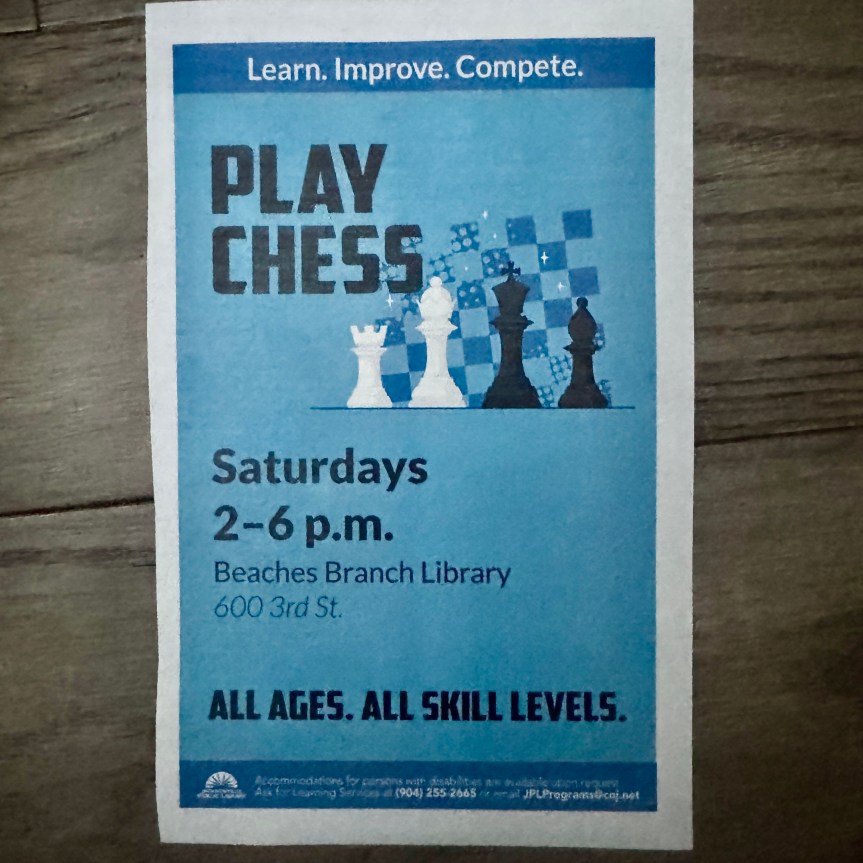
Every Saturday from 2-6PM at the Beaches Branch Library, you can drop in and play chess in the conference room. No pre-registration required! All ages and all skill levels are welcome.
You can learn to play, improve your skills, and compete with other players.
The Benefits of Playing Chess
Chess has endured for centuries not just as a game, but as a mental workout that rewards patience, foresight, and creativity. Whether learned at a young age or discovered later in life, chess offers a wide range of cognitive, emotional, and social benefits that extend far beyond the board.
Strengthens Critical Thinking and Problem-Solving Skills
Every move in chess presents a problem that needs solving. Players must evaluate positions, anticipate consequences, and adjust strategies in real time. This constant decision-making sharpens logical reasoning and encourages players to think several steps ahead. Over time, these skills naturally transfer to real-world situations that require analysis and planning.
Improves Memory and Concentration
Chess players rely heavily on memory, recalling patterns, openings, and previous games. Regular play strengthens both short-term and long-term memory while also improving focus. A single lapse in attention can change the outcome of a match, so chess trains the mind to stay engaged and attentive for extended periods.
Encourages Patience and Emotional Control
Unlike fast-paced games, chess rewards calm and deliberate thinking. Players learn to slow down, manage impulsive decisions, and remain composed under pressure. Losing a game can be frustrating, but it also teaches resilience and how to reflect on mistakes constructively rather than emotionally.
Boosts Creativity and Strategic Thinking
While chess is grounded in logic, it also leaves room for creativity. Unique positions often require inventive solutions, and players are encouraged to experiment with unconventional ideas. This blend of structure and imagination helps develop flexible thinking and the ability to approach challenges from multiple angles.
Builds Confidence and Decision-Making Skills
Making choices independently is at the heart of chess. Each move reflects a personal judgment call, and players quickly see the results of their decisions. Over time, this builds confidence and reinforces accountability, both valuable traits in academics, work, and everyday life.
Supports Academic and Cognitive Development in Children
For children, chess can be especially beneficial. Studies and classroom experiences often link chess instruction to improved math skills, reading comprehension, and attention spans. Beyond academics, chess helps children learn sportsmanship, respect for opponents, and how to handle both success and failure gracefully.
Offers Lifelong Mental Engagement
Chess is a game that grows with you. Beginners can enjoy simple matches, while advanced players explore deep strategy and theory. Because it challenges the brain at every level, chess provides long-term mental stimulation and is often recommended as a hobby that supports cognitive health as people age.
A Game with Benefits Beyond the Board
Chess is more than a pastime—it is a tool for mental growth, emotional balance, and lifelong learning. Whether played casually at home or competitively in tournaments, the skills developed through chess can positively shape how players think, learn, and interact with the world around them.
So be sure to drop in to the Beaches Branch library at 600 3rd St., Neptune Beach, on Saturdays and check it out!
Discover more from Friends of the Beaches Branch Library
Subscribe to get the latest posts sent to your email.
 Friends of the Beaches Branch Library
One thought on “Learn to Play Chess at the Library”